Armin Hansen · 1886–1957
Armin Hansen: a biography
San Francisco-born and trained in Germany, Armin Carl Hansen spent years crewing on North Sea fishing vessels before settling in Monterey, where he became California's foremost painter of men and the sea and one of the most influential teachers on the Monterey Peninsula.
San Francisco and Alameda
Armin Carl Hansen was born in San Francisco on October 23, 1886, the son of Herman Wendelborg Hansen, a German-born illustrator and painter of the American West known for his cowboys and horses. The family moved to Alameda in 1891, and his father gave him his first lessons in drawing and watercolor. From about 1901 he studied at the Mark Hopkins Institute of Art (the former California School of Design) under Arthur Mathews, among others. His studies there ended in 1905, and after the earthquake and fire of April 1906 he left for Europe.
Stuttgart and the North Sea
In Germany Hansen was drawn to the vigorous marine paintings of Carlos Grethe and enrolled at the Royal Academy in Stuttgart to study with him; he also spent a short time at the Munich Academy. From 1908 he spent long periods on the Belgian coast at Nieuwpoort and, to earn a living and learn the sea at first hand, shipped out as a deckhand on merchant and fishing vessels in the North Sea, among them a Norwegian steam trawler. He exhibited in Belgium, including at the Brussels exposition of 1910, and began making prints. Those years among working crews gave him his lifelong subject.
Monterey
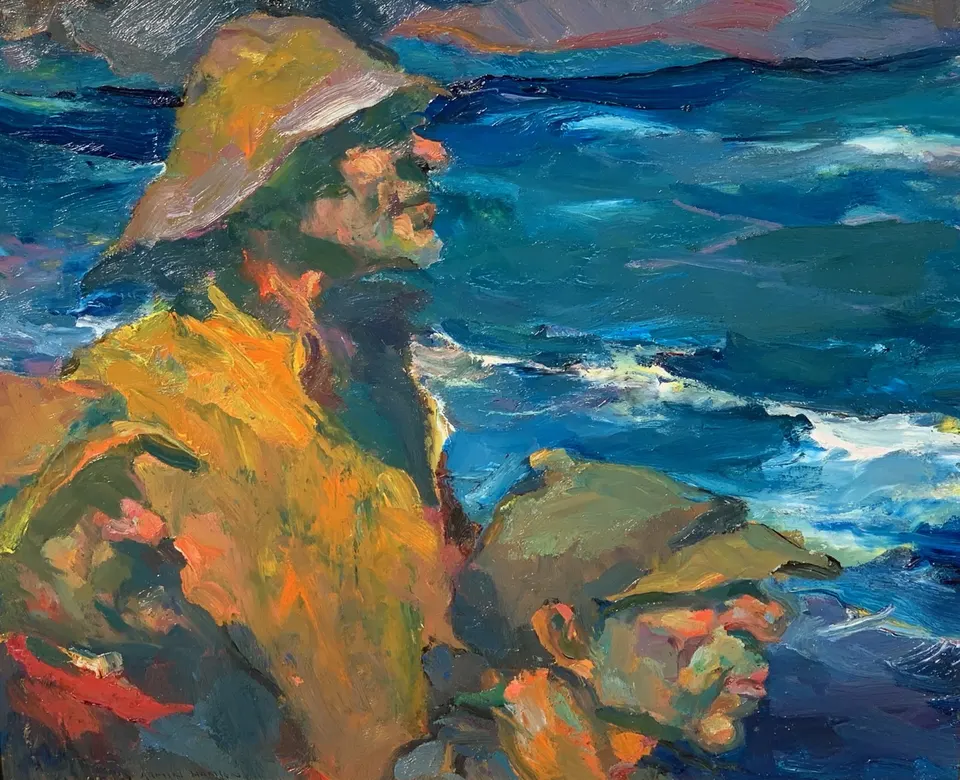
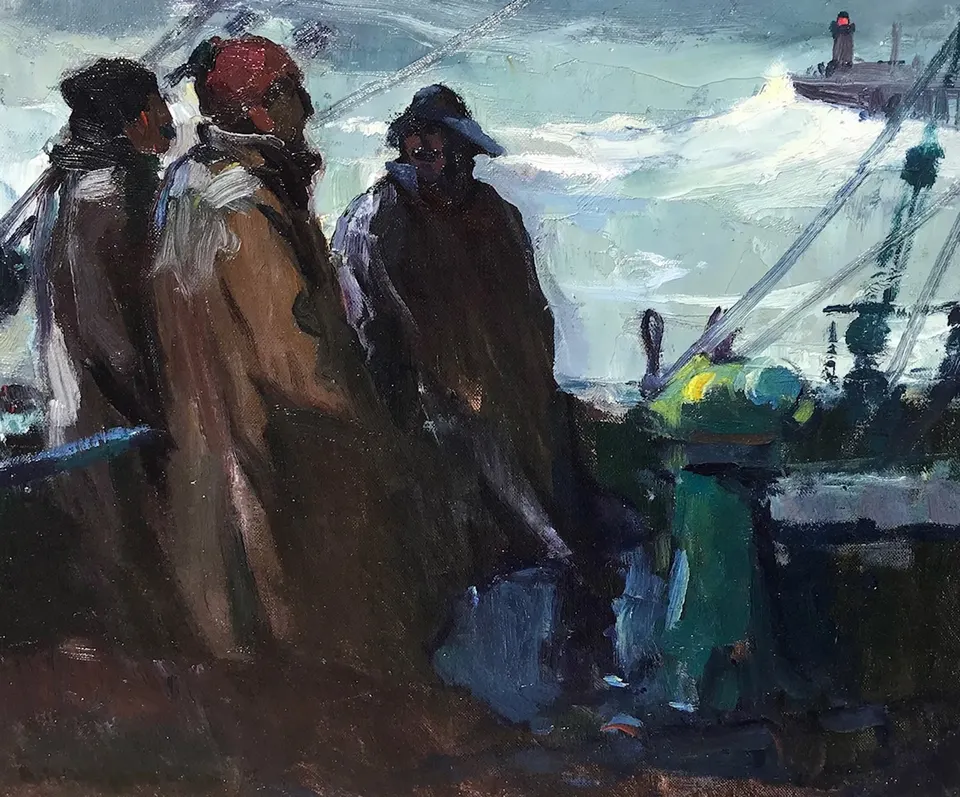
Hansen returned to San Francisco late in 1912 with a large body of European work, shown at several San Francisco galleries in 1913. He first visited Monterey in 1913 and soon made it his home. There he painted the sardine and salmon fleets, the wharf and the fishermen he lived among, in oil, watercolor and etching, with a broad, structural brushwork and strong color that set him apart from the gentler Impressionism of many of his California contemporaries. Major works such as The Salmon Trawlers (1923) and Sardine Barge (about 1933) are in the collection of the Monterey Museum of Art.
A New York exhibition arranged with the help of his fellow marine painter William Ritschel around 1918 brought him national attention, and the National Academy of Design elected him an Associate in 1926 and a full Academician in 1948. His work was included in the art competitions of the 1932 Los Angeles Olympic Games.
Teacher and community figure
Hansen was one of the most sought-after teachers on the Monterey Peninsula; students and colleagues who worked with him included E. Charlton Fortune and Clayton S. Price. He served as president of the Carmel Art Association, co-founded the Carmel Art Institute in 1938, and was among the founders of the Monterey History and Art Association. He also led artists who opposed a redevelopment plan that threatened Monterey's Fisherman's Wharf, a central subject of his art.
Legacy
Armin Hansen died in Monterey in 1957. His paintings and prints are held by the Monterey Museum of Art, the Crocker Art Museum, the Fine Arts Museums of San Francisco, the Oakland Museum of California, the Los Angeles County Museum of Art, the Smithsonian American Art Museum and the Irvine Museum, among others. A major monograph, Scott A. Shields' Armin Hansen: The Artful Voyage, appeared in 2015.
Thinking of selling a Hansen? See how Steven Stern Fine Arts can help.
Sources
Written for arminhansenart.com; facts were checked against the sources below.
- National Academy of Design, "Armin Carl Hansen" (ANA 1926; NA 1948). nationalacademy.emuseum.com (accessed October 2026).
- Smithsonian American Art Museum, "Armin Hansen." americanart.si.edu (accessed October 2026).
- Crocker Art Museum, Drifting Fog by Armin Hansen, catalogue note. crockerart.org (accessed October 2026).
- Monterey Museum of Art, "Armin C. Hansen." collections.montereyart.org (accessed October 2026).
- Wikipedia, "Armin Hansen." en.wikipedia.org (accessed October 2026).
- Scott A. Shields, Armin Hansen: The Artful Voyage, Pomegranate, 2015.